Replacement Intent
What Is an HVAC Replacement Lead?
General HVAC demand can include an AC that is not cooling, furnace repair, maintenance, a thermostat issue, or a diagnostic request. Replacement-oriented intent is different: the homeowner may be replacing an aging AC or furnace, considering a heat pump, evaluating a complete HVAC system, exploring ductless options, or researching replacement costs and financing.
Replacement leads often deserve their own website journey because the decision can involve a larger purchase, equipment choices, pricing questions, financing considerations, more than one decision-maker, and a longer consideration period than an emergency repair. That does not describe every homeowner, but it explains why a generic service form may not collect the context a replacement team needs.
A replacement-focused experience can educate first and capture the opportunity naturally. See the broader guide to generating more HVAC replacement opportunities from website traffic.
Two Dimensions
More HVAC Leads Isn't Always the Same as More Opportunity
How many opportunities entered the pipeline?
How relevant, understandable, and actionable are those opportunities?
Volume still matters. A contractor needs opportunities entering the pipeline. But one company could receive many inquiries with almost no context, while another receives fewer inquiries that explain considerably more about each homeowner's project. Counting submissions alone does not describe that difference.
Quality and quantity are separate dimensions rather than opposites. A healthy acquisition strategy may care about both: enough opportunities to support the business and enough information to route, prioritize, and continue each conversation appropriately. There is no universal volume, conversion rate, or cost-per-lead benchmark that defines success for every contractor.
Six Useful Signals
The Anatomy of a High-Quality HVAC Replacement Lead
Service Fit
Does the requested project match what the contractor sells and where it works?
Project Context
Is the homeowner considering AC, furnace, heat pump, mini-split, or a complete system?
Pricing Context
What estimate or contractor-configured pricing has the homeowner already viewed?
Buying Stage
Is the homeowner researching, planning, or indicating readiness to schedule?
Lead Source
Did the opportunity come through search, advertising, social, referral, or direct traffic?
Contact Information
Does the team have a practical, permission-appropriate way to continue the conversation?
These signals combine intent, fit, context, and the ability to take a next step. Contact information remains necessary, but it becomes much more useful when paired with the project being considered and the homeowner's experience so far.
Buying stage is not a promise. “Researching,” “planning,” or “ready to schedule” describes useful context the homeowner provides; it does not allow software or a salesperson to know whether the project will close. Lead-source data can also be helpful without being perfectly complete or attributable.
Before the First Call
Generic HVAC Lead vs. Context-Rich Replacement Lead
Generic Form Lead
- Name
- Phone
- Message
Questions left open: Repair or replacement? Which system? What expectations do they have? Where did they come from? What should the team discuss first?
Context-Rich Replacement Lead
- Contact details
- Replacement category
- Estimate or quoted amount
- Buying stage
- Lead source
- Relevant quote context
The second lead is not automatically more likely to buy. It simply gives the contractor more useful information before follow-up. A traditional form can still be the right path for direct-contact shoppers or unusual work; the comparison guide explains where an HVAC pricing calculator and contact form each fit.
Intent Spectrum
What Does Buying Intent Actually Mean?
None of these stages guarantees a purchase. Buying intent is a spectrum of signals, not a verdict about the person. A visitor researching pricing can still be valuable because the contractor becomes part of the decision process earlier and may have an opportunity to provide useful guidance.
A website can ask which statement best describes the visitor's current stage. It cannot read the homeowner's mind or determine whether that person will ultimately buy.
A Better Starting Point
Pricing Context Changes the First Conversation
“I need an HVAC estimate” gives the contractor almost no indication of what the homeowner has explored. Knowing that the homeowner viewed a contractor-configured estimate for a complete-system replacement creates a different starting point. The team can acknowledge the option and pricing already shown, then clarify needs and next steps.
This does not mean the estimate is final, the homeowner accepted it, the project has been technically verified, or the opportunity is guaranteed to close. It means the contractor is not beginning completely blind.
That distinction is explored further in the guides comparing an online estimate with an in-home review and deciding how much HVAC pricing to show online.
Marketing Context
Know Where the HVAC Lead Came From
Lead-source context can help a contractor compare which channels are producing replacement opportunities. Common source groupings may include organic search, Google Ads or other paid search, social media, referral traffic, direct visits, and other campaigns.
Attribution is rarely perfect. A homeowner may encounter several touchpoints, switch devices, block tracking, or return directly after an earlier campaign visit. Source information should therefore be treated as a useful signal rather than unquestionable proof.
It can support better marketing questions—such as which campaigns create replacement inquiries—without implying closed-loop revenue attribution, automatic ad optimization, CRM syncing, or any other unverified automation.
Design the Journey
Your Website Influences the Information You Receive
If the only conversion option is “Name + Phone + How Can We Help?” the contractor should not be surprised when website leads arrive with little context. The form collected exactly what it asked for.
A replacement-focused website can introduce system choices, pricing education, financing information, online estimate tools, clear next steps, and contextual lead capture as part of a useful homeowner journey. The information should be collected because it improves pricing, routing, or follow-up—not merely because another field can be added.
Use the HVAC replacement landing-page framework to structure the broader experience, and the implementation guide for adding an HVAC pricing calculator when online pricing is appropriate.
Respect the Visitor
Better Qualification Doesn't Mean More Friction
High-Friction Experience
Twenty questions → personal information → more questions → “Thanks, someone will contact you.”
The visitor may feel like they completed an application without receiving useful value.
Value-Oriented Experience
Simple guided questions → useful pricing or options → logical contact capture → clear next step.
The information exchange helps both homeowner and contractor.
There is no exact ideal number of questions for every company. Each question should have a reason to exist. Remove fields that do not affect the experience, routing, estimate, or follow-up. Sequence necessary questions so the visitor understands what they receive in return.
Stay in Scope
Don't Turn Lead Qualification Into a Full HVAC Inspection
A website does not need to determine every technical detail to create a useful replacement lead. Exact Manual J sizing, detailed duct condition, electrical modifications, hidden installation conditions, code requirements, unusual access issues, final equipment selection, and final project scope are often better verified by the contractor.
That boundary protects credibility and keeps the experience focused. Lead qualification should establish what the homeowner is exploring and whether the opportunity appears relevant. It should not pretend to complete the technical evaluation that belongs in the contractor's professional process.
Practical Review
HVAC Replacement Lead Quality Checklist
- Is this a service we provide?
- Is the property within our service area?
- Do we know which replacement category the homeowner is considering?
- Do we know what pricing or estimate the homeowner viewed?
- Do we understand the homeowner's approximate buying stage?
- Do we have useful lead-source context?
- Do we have enough contact information to follow up appropriately?
- Does the homeowner understand that the estimate may require verification?
- Is there a clear next action for the team and homeowner?
Not every lead needs every field to be valuable. Use the checklist as a review framework, not a rigid scoring system that discards anyone who leaves one detail unknown.
SurePrice
How SurePrice Adds Context to HVAC Replacement Leads
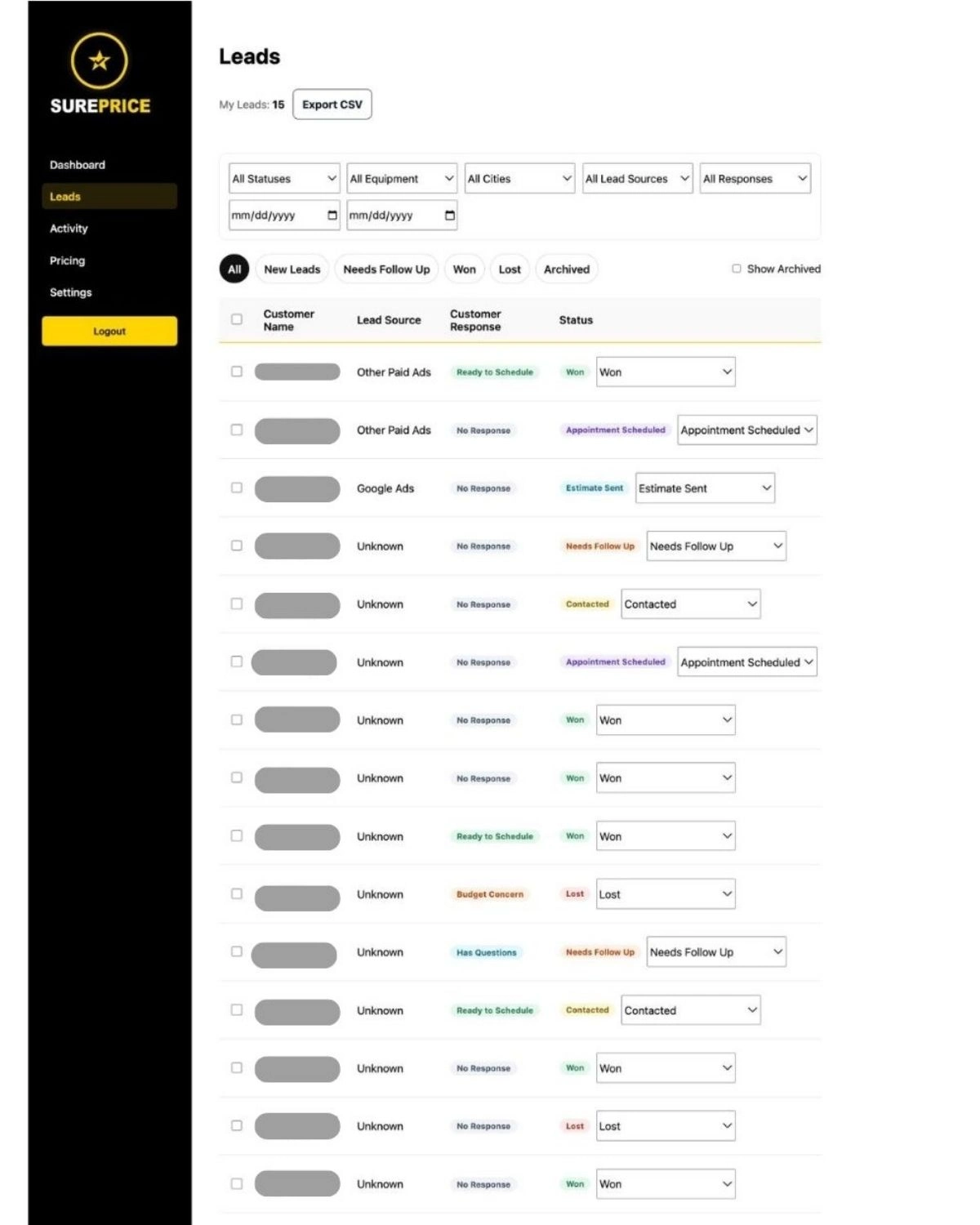
SurePrice gives HVAC contractors a contractor-controlled online pricing experience for their website. A homeowner explores replacement options and receives pricing context. When the opportunity is captured, the contractor can receive customer information, the system requested, quoted amount, buying stage, lead source, and relevant quote context.
SurePrice does not determine whether a homeowner will buy or guarantee lead quality. It gives the contractor more context about the opportunity, which then continues through the contractor's existing sales process.
Evaluate the Pipeline
Measure More Than Raw Lead Count
Metrics a contractor may want to evaluate include replacement inquiries, qualified replacement opportunities, appointment requests, lead source, system or service requested, estimate activity, booked opportunities, and ultimately sold work where the contractor's systems allow that measurement.
This is a conceptual measurement framework, not a list of SurePrice reporting features. SurePrice currently provides useful lead context such as customer information, system requested, quoted amount, buying stage, lead source, and quote context. Other operational or revenue outcomes may live in the contractor's existing systems and require separate processes to evaluate.
The purpose is to avoid treating every form completion as identical. A team can look at both how many opportunities arrive and whether it has enough information to understand and continue them.
Continue Learning
Related HVAC Guides
Browse the complete SurePrice Resource Center.
Common Questions
HVAC Replacement Lead Quality FAQs
What makes an HVAC lead high quality?
A high-quality HVAC lead combines relevant service intent, project fit, useful context, and enough contact information for the contractor to take a sensible next step. High quality does not mean guaranteed to buy.
What is an HVAC replacement lead?
An HVAC replacement lead is an inquiry from someone considering replacing an air conditioner, furnace, heat pump, mini-split, or complete system rather than requesting only repair, maintenance, or diagnosis.
What information should an HVAC replacement lead include?
Useful information can include contact details, replacement category, estimate or pricing context, buying stage, lead source, service location, and relevant quote selections. Not every valuable lead needs every field.
Is lead quality more important than lead quantity?
Both matter and measure different things. Volume shows how many opportunities entered the pipeline, while quality describes how relevant and actionable those opportunities are. A healthy acquisition strategy may evaluate both.
How can HVAC companies qualify website leads?
Contractors can use replacement-specific pages, guided system choices, pricing education, a focused online estimate, relevant contact capture, and clear next steps. Each question should help pricing, routing, or follow-up without creating unnecessary friction.
Does showing HVAC pricing improve lead quality?
Showing pricing can add context and let homeowners compare a replacement with the range they expected, but it does not universally improve every lead. Lead quality also depends on service fit, intent, project details, source, and the website experience.
What is buying intent in HVAC lead generation?
Buying intent describes signals about where someone may be in the decision process, from early research and price exploration to requesting a conversation or appointment. It is context, not a prediction or guarantee of purchase.
Can an online HVAC estimate replace lead qualification by a salesperson?
No. An online estimate can collect useful project and pricing context, but the contractor still needs to verify fit, understand the homeowner's needs, confirm technical details, and continue the opportunity through its normal sales process.
Bottom Line
Give Your Team More Than a Phone Number
A useful HVAC replacement lead combines project intent, service fit, pricing context, buying stage, source, and a practical path to follow up. That context helps the contractor understand the opportunity without pretending to predict the outcome.
Better lead capture is not about interrogating the homeowner. It is about creating a website journey that provides value and collects the information needed for the next sensible conversation.