Understand the Visitor
Replacement Visitors Don't Behave Like Repair Visitors
Emergency / Repair Visitor
- System stopped working
- Wants immediate help
- Often ready to call
- Speed and availability matter heavily
- A simple “Call Now” CTA may work
Replacement Visitor
- Making a larger financial decision
- Comparing companies and equipment
- Researching financing and pricing
- May involve another decision-maker
- May return several times before converting
Using the same page structure for both intents can leave replacement opportunities on the table. A service page optimized for urgency may not answer the questions behind a planned replacement. See the broader strategy for getting more HVAC replacement leads from existing website traffic.
Page Framework
The Anatomy of a High-Converting HVAC Replacement Page
The exact order can change, but a useful page usually needs the following building blocks:
Clear Replacement-Focused Hero
Identify the decision and service immediately.
Immediate Value Proposition
Explain how the page helps the homeowner.
System Options
Describe the replacement paths actually offered.
Pricing Context
Answer the cost question at an appropriate level.
Financing Information
Make available payment paths easy to understand.
Trust Signals
Show specific, verifiable reasons to choose the company.
Replacement Process
Reduce uncertainty by explaining what happens next.
Online Pricing CTA
Serve researchers who want pricing before a call.
Consultation CTA
Serve visitors ready to speak or book.
FAQs and Objections
Resolve common questions near the decision.
Final Next Step
End with a clear, relevant action.
Above the Fold
Start With the Homeowner's Replacement Decision
Generic hero copy such as “Quality HVAC Services You Can Trust” says little about why the visitor came. Replacement-specific messaging should make the service intent obvious and help the homeowner understand what they can do on the page.
Language such as “Explore Your HVAC Replacement Options” or “See Heating and Cooling Replacement Options for Your Home” is more specific, although no single phrase is universally optimal. The hero should reflect the contractor's actual services, location when relevant, and the page's primary next step.
Avoid filling the first screen with generic company claims. Lead with the replacement decision, then support it with credibility and a clear CTA.
CTA Strategy
Don't Force Every Replacement Shopper Into the Same CTA
A single “Contact Us” button assumes every visitor is ready for the same commitment. A small, consistent CTA ladder can serve several stages without cluttering the page.
Keep labels consistent and avoid presenting every action as equally prominent. The guide comparing an HVAC pricing calculator with a contact form explains where each conversion path fits.
Cost Questions
Give Replacement Shoppers Useful Pricing Context
Cost is one of the largest unanswered questions on many replacement pages. Contractors can choose among several levels of transparency:
No Pricing
The visitor must call to learn anything about cost.
Pricing Education
Explain which factors change project investment.
Example Ranges
Give context without tailoring it to the home.
Online Estimate
Use contractor-configured logic and guided inputs.
Every contractor does not need to publish a guaranteed final installed price. Ductwork, electrical requirements, permits, accessibility, equipment configuration, and site conditions may change final scope.
Explore the considerations behind showing HVAC prices online, learn how homeowner-facing HVAC estimates work, or use the implementation guide for adding an HVAC pricing calculator to a website.
Affordability
Treat Financing as Part of the Buying Decision
HVAC replacement is a major purchase, and some homeowners evaluate affordability through payment options as well as total project cost. If financing is offered, make that fact easy to find, explain the available path accurately, and present payment information where appropriate.
Do not bury financing in the footer or make misleading approval claims. Avoid invented lender terms, rates, or monthly examples. The page should help the homeowner understand that financing may be available and how to learn more without promising an outcome.
Credibility
Show Proof Where the Homeowner Is Making the Decision
Use genuine trust signals near the decisions they support: real customer reviews, licensing information, actual team and installation photos, warranties, truthful years in business, legitimate manufacturer certifications, service area, real guarantees, and supportable case studies.
Specific proof is more useful than “We're the best.” Installation photos can support installation claims. Warranty details can sit near equipment information. Reviews should be real and attributable. Avoid fake badges, invented awards, and stock-heavy sections that look credible without proving anything.
Reduce Uncertainty
Show Homeowners What Happens Next
A simple process makes the next action feel more predictable:
The process should distinguish online context from professional verification. It also shows that requesting information is not an irreversible commitment.
Value Exchange
Give Visitors Something in Return for Their Information
“Fill this out and we'll contact you” can work for people already ready to talk. “Answer a few questions, explore relevant replacement pricing, then choose your next step” gives a researcher useful information during the visit.
Traditional forms still make sense for service requests, unusual projects, commercial work, complex situations, and visitors who prefer direct contact. A replacement page can provide both paths rather than declaring one universally superior.
Lead Context
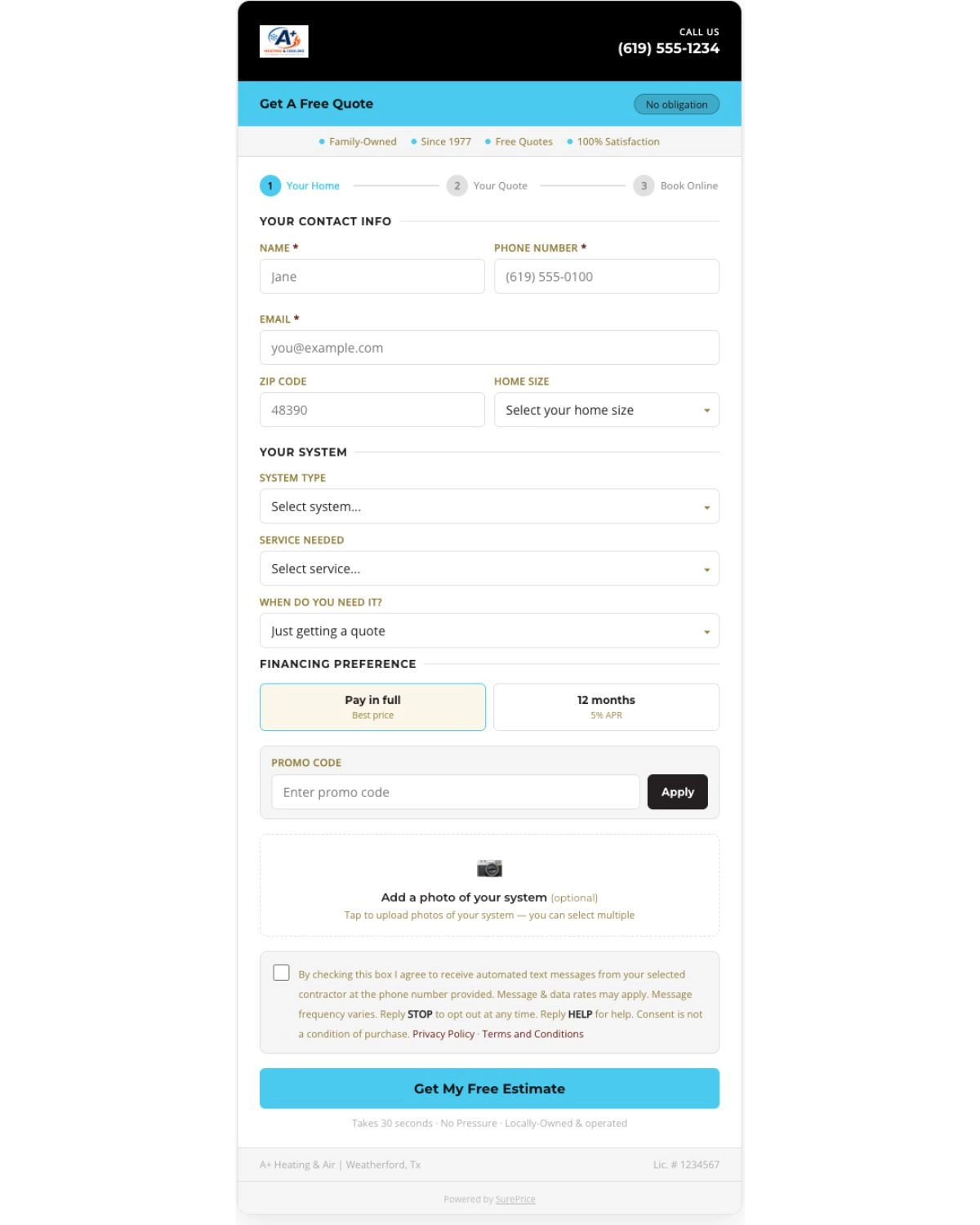
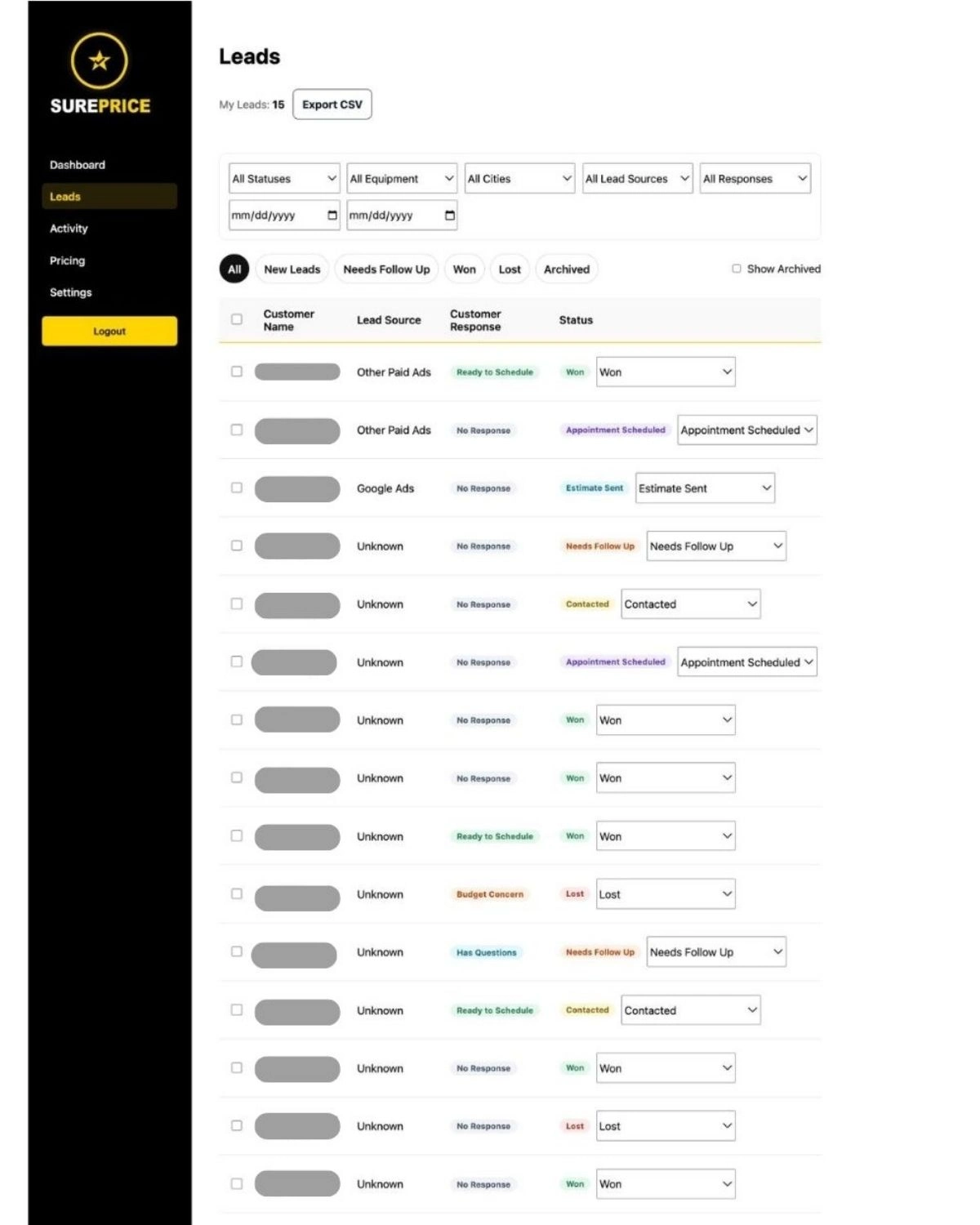
Capture Context, Not Just Contact Information
A replacement opportunity is more useful when it includes customer contact information plus the system requested, estimate shown, buying stage, lead source, and relevant selections where collected. That gives the sales team a better starting point than a generic “I'd like an estimate” submission.
This does not require replacing or automatically syncing with a CRM. The contractor can continue the opportunity through its existing sales and operational workflow.
Small Screens
Design the Replacement Page for a Phone First
Use short sections, readable text, large tap targets, fast-loading assets, and a clear CTA hierarchy. Keep pricing legible, forms reasonable, calculators responsive, navigation simple, and the next action easy to find.
Avoid intrusive popups and giant forms that cover the content. A long replacement guide can work on a phone when it is broken into meaningful sections and visual components rather than one wall of text.
Avoidable Problems
Common HVAC Replacement Landing Page Mistakes
Treating replacement like emergency repair
Researchers need more education than an urgent service shopper.
Using only “Call Now”
Offer a useful path for visitors not ready to talk.
Hiding all pricing information
Explain cost factors or provide appropriate online context.
Asking too much before providing value
Keep questions relevant to pricing or qualification.
Using generic stock-heavy trust messaging
Show specific, verifiable proof instead.
Burying financing
Make available purchase paths visible during research.
Explaining equipment but not the process
Tell homeowners what happens after they engage.
Sending everyone to one generic form
Match next steps to different levels of buying intent.
Hand-Off Framework
A Practical HVAC Replacement Landing Page Blueprint
A contractor can hand this conceptual sequence to a website partner. Exact order may vary based on traffic source and service offering.
SurePrice
Where Online Pricing Fits Into the Replacement Page
SurePrice gives HVAC contractors a way to add contractor-controlled replacement pricing to their website. Homeowners can explore replacement options and pricing, the contractor receives lead context, and the opportunity continues through the contractor's existing sales process.
SurePrice is not a CRM, scheduling platform, dispatch system, or replacement for the contractor's website or sales team. See the complete HVAC pricing software experience.
Continue Learning
Related HVAC Guides
Browse the full SurePrice Resource Center.
Common Questions
HVAC Replacement Landing Page FAQs
What should an HVAC replacement landing page include?
It should explain replacement options, pricing factors, financing availability, why the contractor is credible, what the replacement process looks like, and several clear next steps for different levels of buyer intent.
Should an HVAC replacement page show prices?
Useful pricing context can help homeowners evaluate replacement, but it does not have to be a guaranteed final installed price. Contractors can use pricing education, ranges, calculators, or contractor-configured online estimates with clear scope language.
Should I use a contact form or pricing calculator?
Both can be useful. A contact form serves homeowners ready for direct consultation, while a pricing calculator can help researchers understand the likely investment before deciding whether to speak with someone.
Should financing be shown on an HVAC replacement page?
If the contractor offers financing, the page should make that availability easy to find and describe it accurately. Avoid unsupported approval claims, invented payment terms, or language that guarantees financing.
How many calls to action should an HVAC landing page have?
There is no universal number. Use a small, consistent set that supports different intent levels, such as exploring options, seeing pricing, requesting an estimate, and calling or booking.
Should AC replacement and furnace replacement have separate pages?
Separate AC, furnace, heat pump, mini-split, or complete-system pages can make sense when each reflects real services, distinct search intent, and genuinely useful unique content. Avoid creating thin pages that repeat the same copy with different equipment names.
What information should an HVAC replacement lead include?
Useful context can include customer contact information, the system requested, relevant replacement selections, the estimate shown, buying stage, and lead source where collected.
Does an online estimate replace an in-home HVAC estimate?
Not necessarily. An online estimate can provide pricing context, while professional review may still be needed to confirm sizing, ductwork, electrical requirements, permits, accessibility, equipment, and final project scope.
Bottom Line
Help the Homeowner Make Progress
A strong HVAC replacement landing page does more than advertise installation. It helps a homeowner understand options, cost, financing, credibility, and process, then offers a next step suited to their current readiness.
That structure serves the researcher without getting in the way of the visitor ready to call, request an estimate, or book.